


How Songs and Repetition Help Kids Learn Language Faster

Updated: Oct 6

A toddler can sing a phrase long before they can explain what it means. That is one reason music is such a powerful tool for early language learning. Songs give children a friendly way to hear new sounds, copy them, repeat them, and slowly connect them to real meaning.
For young kids, language does not begin with grammar rules or vocabulary lists. It begins with sound. They notice rhythm, pitch, facial expression, movement, and patterns. A simple song can turn a new phrase into something familiar enough to try.
That is the heart of using songs and repetition to help children learn faster. Music slows language down. Repetition builds confidence. Movement helps the body remember what the ears hear.
One simple example is a Spanish name song, like a “Yo me llamo” song, that helps children learn how to say their name and ask for another person’s name:
Yo me llamo _______. ¿Cómo te llamas tú?
That short exchange teaches a real social skill. It gives children language they can use right away, with rhythm and repetition making it easier to remember.

Music slows language down so children can hear more
Everyday speech moves quickly. Adults blend sounds, shorten words, change tone, and speak at a pace that can be hard for young children to follow. A sentence like “What is your name?” may sound clear to an adult, but to a toddler it can arrive as one long stream of sound.
Songs change that.
Music naturally stretches words across rhythm and melody. It gives children extra time to hear separate sounds. This is the slow down effect, and it matters more than many adults realize.
When a phrase is sung, children can more easily notice:
Individual sounds inside words
Where one word ends and the next begins
The rise and fall of the voice
Repeated patterns
Stressed syllables
Accent marks and pronunciation differences
Take the Spanish phrase `Yo me llamo`. In natural speech, it might move quickly. In a song, each part can be clear:
Yo
me
lla-mo
The melody gives the child a little space to hear the shape of the phrase. The rhythm supports pronunciation. The repeated tune gives them a structure to hold onto.
This is especially helpful with sounds that do not exist in a child’s home language. Spanish has patterns and pronunciations that may be new to English-speaking children, such as the double `ll` sound in `llamo`, or the open vowel sounds in `me` and `llamo`. Singing gives those sounds more room.
Music also helps children hear accents and word placement. A phrase like `¿Cómo te llamas tú?` has a natural musical quality even when spoken. When children sing it, they begin to feel where the stress goes. They may not know what every word means yet, but they are learning the shape of the sentence.
That matters because language learning is not only about memorizing words. It is also about tuning the ear.
Repetition helps toddlers move from mimicry to meaning
Young children learn through repeated exposure. They hear a sound, watch a mouth move, try to copy it, and try again. At first, they may only mimic the rhythm. Then they begin to copy certain sounds. Later, the words become clearer. Over time, meaning follows.
This path is natural.
A toddler might sing “yo me ya-mo” before saying `Yo me llamo` clearly. That early version still counts. The child is mapping the rhythm of speech. They are practicing the muscle movements needed to form the words. They are connecting sound, breath, and timing.
Repetition builds confidence because the child knows what is coming next. Predictability makes participation feel safer.
When a song repeats the same phrase several times, the child does not have to guess. They can relax, listen, and join when ready.
For example, a name song might follow this pattern:
Adult sings, “Yo me llamo Maya”
Child listens
Adult sings again and points to self
Child watches
Adult sings, “¿Cómo te llamas tú?”
Child hears the question
Adult repeats the song over several days
Child begins to fill in one word, often their own name
At first, the child may only say “Maya.” Later, they may attempt “me llamo Maya.” With enough repetition, they may understand that the phrase means “My name is Maya.”
This is why repetition should not feel like drilling. In early childhood, it works best when it feels like play.
The same short song can be used during circle time, before snack, while getting ready for a walk, or during a diaper change. The more relaxed the setting, the more naturally children absorb the language.
A good language song does not need to be long. In fact, short songs are often better. A simple song with one useful phrase can do more than a long song packed with too many new words.

Children learn faster when language does something useful. Saying a color word is helpful. Counting is helpful. But being able to introduce yourself has an immediate social purpose.
Our “Yo me llamo” song gives children a phrase they can use with another person. It teaches them to say their own name, then ask for someone else’s.
That makes the language feel alive.
Here is a simple version that can be repeated with different names:
Yo me llamo...... (add your name)
yo me llamo __________
¿Cómo te llamas tú? (what's your name?)
The goal is not to perform a perfect song. The goal is to create a steady pattern children can anticipate.
This kind of song teaches several skills at once.
It introduces first-person language
`Yo me llamo` helps children hear how someone talks about themselves. They connect the phrase with a gesture, such as pointing to their own chest.
That physical cue makes the meaning clearer.
It teaches a question pattern
`¿Cómo te llamas tú?` gives children a model for asking about another person. Even if they do not fully understand each word yet, they begin to recognize the sound of a question.
The rising tone, facial expression, and turn-taking all support comprehension.
It supports name recognition
Names are meaningful to children. They hear their own name often. When their name appears inside a song, attention usually increases.
A child who does not repeat the full Spanish phrase may still light up when they hear their name. That emotional connection helps the language stick.
It builds turn-taking
The song naturally invites a back-and-forth pattern. One person sings their name. Then they ask someone else.
That pattern supports conversation skills, not just vocabulary. Children practice waiting, listening, responding, and noticing another person’s turn.
Movement makes new words easier to remember
Children do not only learn with their ears. They learn with their whole bodies.
When music is paired with movement, language becomes more concrete. A gesture can show the meaning of a phrase before a child can explain it.
This is kinesthetic learning, and it is especially useful for toddlers and preschoolers. Movement gives the brain another path to store the word or phrase.
For a “Yo me llamo” song, the movements can be simple:
Spanish phrase | Movement idea |
`Yo` | Point to your chest |
`me llamo` | Tap your chest gently |
Child’s name | Wave or place hands on heart |
`¿Cómo te llamas tú?` | Open hands toward another person |
`tú` | Point gently toward the other person |
These gestures help children understand who is speaking and who is being asked. They also give shy children a way to participate before they are ready to speak.
A child may point, clap, or wave before singing the words. That is still language learning. The body is joining the communication.
Movement also improves attention. Young children are not built to sit still for long lessons. A song with claps, taps, stomps, or gestures gives them a reason to stay engaged.
The movement should support the words, not distract from them. Keep actions clear and repeatable.

Why children do not need to understand every word at first
Adults often want children to understand a new phrase right away. But early language learning does not work in a straight line.
Children often imitate before they comprehend. They may copy the sound of a phrase many times before they attach meaning to it. This is not a problem. It is a normal part of learning.
Think about how children learn favorite songs in their first language. They may sing lines with unclear words, made-up sounds, or mixed-up phrases. Later, the words sharpen. Meaning catches up.
The same thing happens in a new language.
What adults should hope for
Progress in early language learning can be quiet. A child might not sing the whole song right away. That does not mean the song is not working.
Clear pronunciation may come later. Comprehension may appear before speech. Some children listen for a long time before they join. Others jump in with bold, imperfect attempts.
The goal is repeated, joyful contact with language.
You Don’t Have to Do It All
As parents, we already have plenty on our plates. Enriching your child’s life with music and language doesn’t have to mean adding another activity, buying lots of materials, or following a perfect routine.
It can be as simple as singing while you get dressed, counting pumpkins while decorating for Halloween, or playing a favorite Spanish song on the way to school.
Small, joyful moments add up. Your child is learning to listen, imitate, communicate, and connect with you along the way.
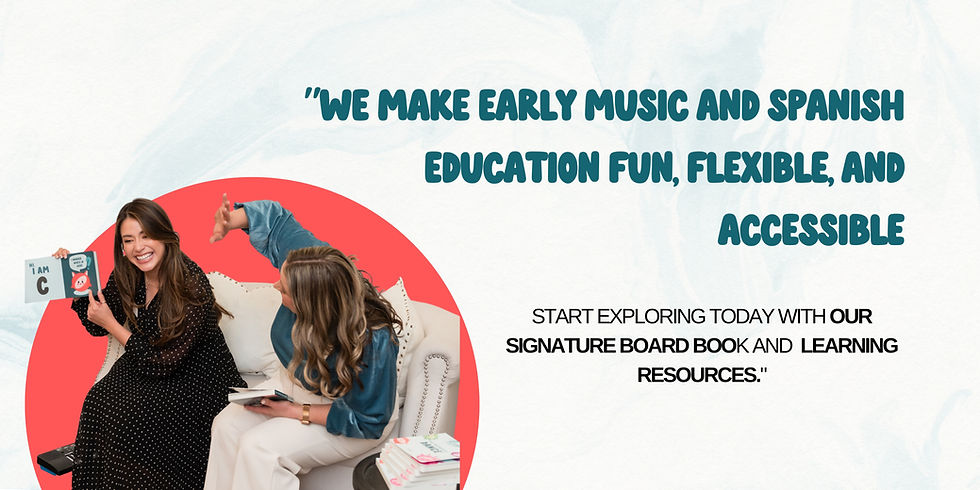
At Little Chords, we’re two moms and music educators who create resources to help families bring more music and language into everyday life. We want you to feel confident sharing these experiences with your children, even if you’re learning alongside them.
This fall, give yourself permission to keep it simple: press play, sing together, and let the learning unfold.
Ready to bring more music and Spanish into your family’s routine?
Explore the Little Chords website for our children’s music book, playful learning resources, and activities designed to help little learners discover the joy of music and language.
You don’t have to be a musician or speak perfect Spanish to get started. Curiosity is the only requirement!
Visit Little Chords Learning Library and find your next little moment of music and learning.
Comments